
Anthony Allen enjoys a diverse life in music, and has played modern and baroque flutes, baroque violin, recorder, and viola da gamba, and has been known to occasionally be heard as a bass vocalist. Early in his career he was founder and director of the Portland (Maine) Early Music Consort, an instrument/vocal ensemble devoted to playing music from the medieval through baroque periods that performed in the New England region.
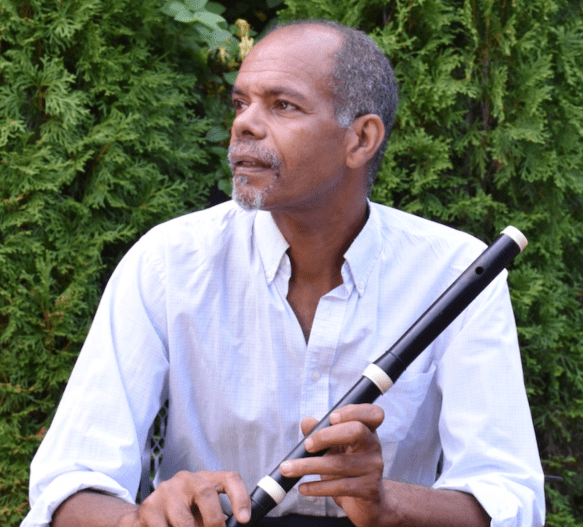
For 18 years he was a member of the Maine State Ballet Orchestra as a flutist and piccolo player, performing some of classical ballet’s finest scores including Prokofiev’s Cinderella and Peter in the Wolf, Debussy’s Afternoon of a Faun, Delibes’ Coppelia, Mendelsohn’s A Midsummer’s Night Dream, and of course Tchaikovsky’s Sleeping Beauty and The Nutcracker. He has also performed with the Portland Opera Repertory Theater Orchestra and the Maine Chamber Ensemble.
Focusing on the violin later in life than is the norm, Anthony started playing baroque violin at age 27, and went on to study baroque violin as an undergraduate several years later. He has performed with the Newport Baroque Orchestra (Rhode Island), Boston Cecilia, and the Arcadia Players Chamber Orchestra (Massachusetts). In Oregon, Anthony has performed on violin, flute and recorder with the St. James Bach Cantata Vespers Orchestra and has been principal violinist with The Ensemble in performances of Purcell’s Dido and Aeneas, Blow’s Venus and Adonis, and Gluck’s Orfeo ed Euridice.
An educator for many years, Anthony directed the orchestra and string program at the Eugene Waldorf School (OR) and the Chestnut Hill School in Newton, Massachusetts. He founded a violin and recorder program at the Catherine Ellison-Rosa Parks School in Mattapan, MA, and taught flute and recorder at Bates College, the Portland Conservatory of Music, and the Maine School for the Performing Arts. He is a graduate of the Longy School of Music in Cambridge, Massachusetts with a double major in baroque flute and baroque violin.
“Join us as we spring into longer daylight hours and celebrate the music of the Baroque. We will start with a Ballo by Lorenzo Allegri, a set of five-part dances written for La Serena, a Venetian court celebration put on in 1611. While the Ballo was a product of the Renaissance, in Allegri we can hear the harmonies of the nacent baroque, as well as the use of basso continuo and the emerging trio sonata texture. This is followed by a Pavana by Carlo Farina, a Mantuan composer and virtuoso violinist who made many important contributions to violin technique, as well as to the development of the violin sonata. Our Pavana, written in 1627 and titled after himself, presents the pavan in its twilight years, as the form would soon cease to be used by composers. We end our session with selections from Handel’s festive and joyous Water Music, showcasing the baroque in its heyday. We hope to see you there soon, and don’t forget to set your clocks ahead!!”
Anthony Allen
This music is for the use and enjoyment of this particular workshop, and may be protected by copyright. This music is for educational purposes only. Please do not distribute this music outside this workshop.
Click below to download and print the music
—Ballo detta de Serena
• Ballo della de Serena, early notation
• Ballo della de Serena all 5 parts
—Pavana di Carlo Farina a 4
• Canto
• Alto
• Tenor
• Bass
—Water Music: Allegro and Hornpipe
• Soprano 1
• Soprano 2
• Alto
• Tenor
• Bass
 Portland Recorder Society